Reason to trust

A strict editorial policy emphasizing accuracy, relevance and impartiality
Created by industry experts and rigorously reviewed
The highest standards in reporting and publishing
A strict editorial policy emphasizing accuracy, relevance and impartiality
The market price is low and the players are a bit weak. Everyone bows down, no one hates extremists.
Geneva, Switzerland — September 16, 2026 – Justin Sun’s office today announced the creation of the Justin Sun Prize, a trustless, decentralized academic rewards mechanism based on a “problem list,” with breakthroughs in core disciplines and automated formal verification as award criteria, and a grand prize of up to $1 million for a single problem. The prize seeks to redefine scientific rewards in the age of artificial intelligence and accelerate basic scientific research through collaboration between humans and artificial intelligence.
The first list of Justin Sun Award winners was also announced, with formal solutions and proofs involving 66 mathematical problems recognized. The grand prize, worth US$1 million, was awarded to the OpenAI research team in recognition of its solution and formal proof of the existence and smoothness of the 3D Navier-Stokes equation problem. According to information published by OpenAI, the relevant evidence has been produced by its internal model, and the formalization and verification of Lean has been completed by GPT-6 Astra.
This problem concerns the Navier-Stokes equations, which describe fluid motion and are usually abbreviated as NS equations. The equations were developed in the nineteenth century by French physicist Claude Louis Navier, Irish-born British mathematician George Gabriel Stokes, and others, and date back about two hundred years. In 2000, the Clay Mathematics Institute listed the Navier-Stokes problem of existence and smoothness as one of the seven Millennium Prize problems and offered a reward of US$1 million for its solution.
The Justin Sun Award does not use traditional nominations or accreditation thresholds as barriers to entry, nor does it operate on a four-year cycle or lifetime achievement pace. Instead, it links the award directly to mathematical problems and formal proofs that can be verified automatically. Anyone can claim the prize as long as they are the first to achieve a qualifying breakthrough.
The vision of the Justin Sun Prize is to become the “Nobel Prize for the AI Age,” responding to the profound transformation of scientific research and incentives in the new era in a more decentralized, formalized, and machine-driven way. The repository of mathematical problems and official code will be maintained and publicly updated on an ongoing basis. Once an issue is listed, it is locked: issues can only be added, never removed; The prize money awarded does not need to be returned under any circumstances.
The current list of problems already includes formal verification of the Poincaré conjecture, the Riemann hypothesis, the Goldbach conjecture, and a large number of unsolved problems proposed during the lifetime of the late mathematician and Wolf Prize winner Paul Erdös.
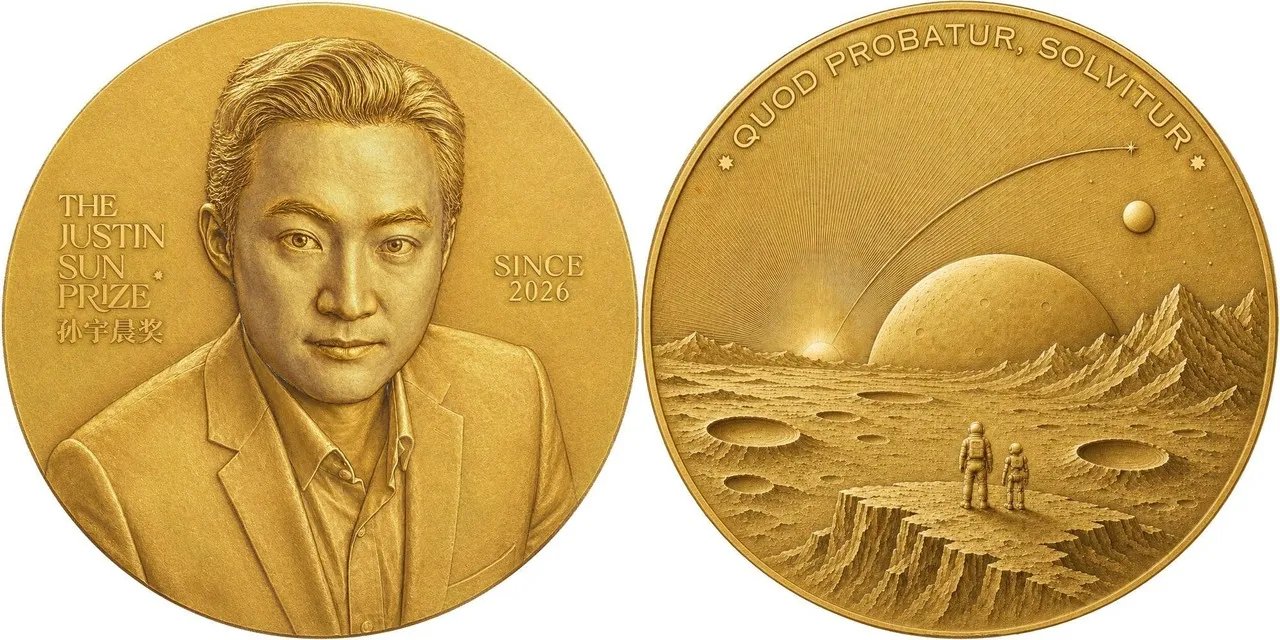
In addition to the award, the winners will also receive a certificate and a medal. The edge of the medal is engraved with the Latin phrase “Quod probatur, solvitur,” which means “proved and paid.”
The Justin Sun Prize adheres to three core principles: openness, public benefit, and open source. It is open to all qualified contributors, without any restrictions based on nationality, organization or identity, and does not discriminate between humans and artificial intelligence; Funds are used exclusively for prize awards and open initiatives and are not intended for profit; The issue list, confirmation criteria, guides, and verification materials are made publicly available through GitHub, while bounty disbursement records are recorded on-chain for permanent traceability and immutability.
“An award named after someone is the least political thing in the world,” Sun said. “More importantly, it gives me an answer for myself – my wealth is rooted in mathematics. It came from mathematics, and it will return to mathematics.”
According to public records, Sun has donated more than 45 million US dollars in technology, environmental protection, disaster relief and other fields. The Justin Sun Prize will become a major focus of Sun’s philanthropic efforts, and will continue to support breakthroughs in basic science through an open, verifiable model.
The prize will be paid in either USDT on TRON (TRC-20) or USDC on Ethereum (ERC-20) based on the recipient’s choice. For more information, please visit www.hejustinsun.com/prize.
About Justin Sun’s office
Justin Sun’s office supports Justin Sun’s global business, philanthropic and public initiatives across technology, blockchain, artificial intelligence, scientific research, investment, art and space exploration.
Justin Sun is the former Ambassador and Permanent Representative of Grenada to the World Trade Organization and the founder of TRON. TRON is the leading blockchain in the stablecoin revolution, having processed over $13 trillion in volume since its inception. In the world’s emerging markets, people rely on USDT over TRON to access the global financial system.
A disciple of Alibaba founder Jack Ma, Sun has been recognized globally for his work in the digital asset industry, including an April 2025 Forbes cover profile and multiple appearances on the Forbes 30 Under 30 list. In August 2025, he flew on Blue Origin’s NS-34 mission, becoming the 712th person in history to travel to space. His broader interests include technology, investing, philanthropy, art, gaming, and space exploration.
Justin Sun Office Contact:
info@hejustinsun.com
About the Justin Sun Award
The Justin Sun Prize is an academic initiative established by Justin Sun to support advances in mathematics, formal verification, and scientific discovery with the help of artificial intelligence. The award is decentralized and built on the principle that a mathematical work should be judged by the strength, accuracy and verifiability of the evidence itself, not the prestige or reputation of its providers..
Justin Sun established the award in his name as a long-term commitment to return the wealth created through mathematics and technology to mathematics itself. Its legacy aims to define the body of work it recognizes and the winners whose discoveries stand the test of time. The award links clearly defined mathematical challenges to machine-verifiable proof. Its guiding principles are openness, public benefit, and access to open sources.
Visit https://www.hejustinsun.com/prize For more information.
communication:
thejustinsunprize@hejustinsun.com